Fit-based buyer guide
OpenRouter alternatives: choose by model access, control and cost
Shortlist managed APIs, BYOK gateways, self-hosted proxies or dedicated inference by the problem you need to solve. Includes a practical partial-migration example. [1] [2] [3] [4] [5] [6] [7] [8] [9] [10]
Last reviewed 2026-09-29 · Editorial review: KeepRouter Editorial
OpenRouter alternatives by reason to switch
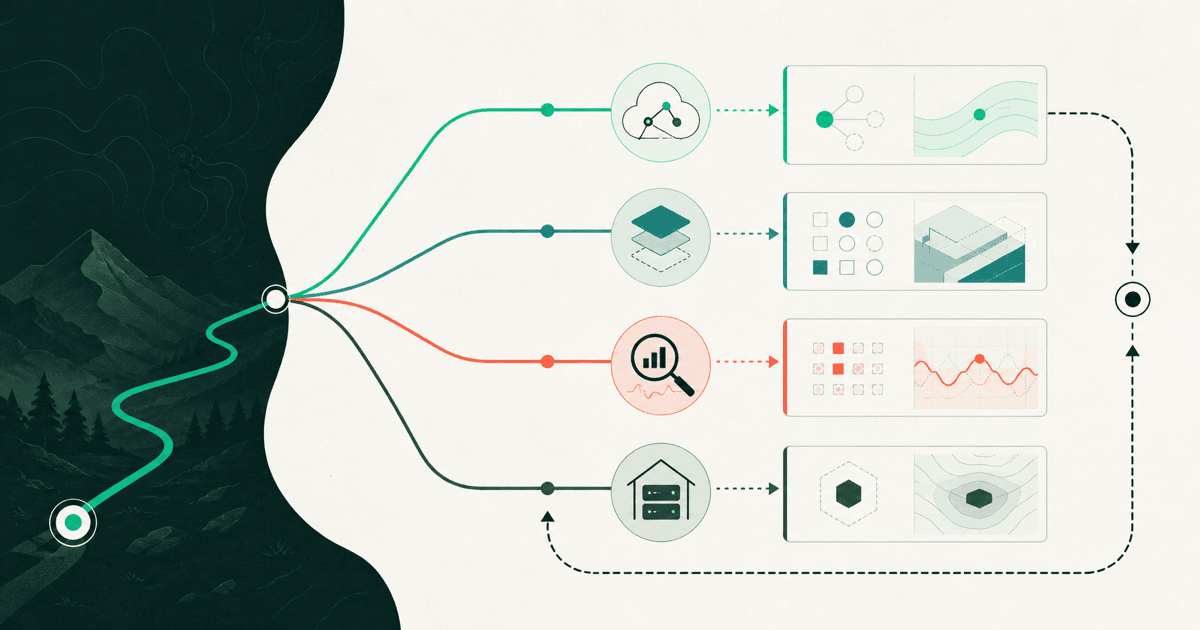
The alternatives solve different problems. Start with the reason you would leave OpenRouter, then compare only products that match that ownership and routing need.
KeepRouter
For a bounded managed catalog, prepaid KeepRouter billing and fewer customer-facing provider choices.
Vercel AI Gateway
For Vercel or AI SDK teams that want managed routing, provider preferences and BYOK.
Portkey
For teams prioritizing a gateway control plane, governance and observability around their own or managed deployment.
LiteLLM
For teams prepared to self-host a proxy and retain infrastructure and provider-account ownership.
Helicone
For an observability-led workflow that joins gateway calls with logs, prompts, sessions and evaluations.
Cloudflare AI Gateway
For Cloudflare users who want AI traffic policy, security and logs in the same control plane.
Hugging Face Inference Providers
For Hugging Face model discovery and task-oriented inference across supported providers.
Together AI
For open-weight models that may move from serverless inference to dedicated serving or training.
Fireworks AI
For open-model inference with serverless and deployment options that a gateway catalog does not provide.
Choose an alternative for the problem you are solving
For managed model access, compare KeepRouter and Vercel AI Gateway. For a gateway around your own provider accounts, consider Portkey or Cloudflare AI Gateway. For a proxy your team operates, evaluate LiteLLM. For dedicated open-weight serving, compare Together AI and Fireworks AI. These are different replacement paths, not a ranking. If OpenRouter's provider controls already meet your needs, keeping it may cost less work than migrating.
A shortlist with a reason to choose each product
| Your main requirement | Candidate | Why investigate it | What would rule it out? |
|---|---|---|---|
| A managed prepaid model catalog | KeepRouter | Published customer prices and supported compatible API routes | Required model or request-level provider control is absent |
| AI SDK gateway integration | Vercel AI Gateway | Gateway SDK and documented routing options | Your required native operation is not represented |
| Central policy for provider accounts | Portkey | Gateway configuration and governance tooling | Needed feature is unavailable in your chosen deployment or plan |
| Cloudflare traffic controls | Cloudflare AI Gateway | Caching, logging, routing and billing options | Recreating account-specific policies would add unwanted work |
| Own the proxy deployment | LiteLLM | Self-operated proxy and provider integrations | Nobody can own upgrades, secrets and incidents |
| Operate dedicated model capacity | Together AI or Fireworks AI | Dedicated-serving paths alongside other inference options | You only need a small amount of managed API traffic |
The product roles are documented by Vercel, Portkey, Cloudflare, LiteLLM, Together AI and Fireworks AI. Check model availability and commercial terms on the specific product before shortlisting it. KeepRouter's catalog is the source for its current customer offering.
Three common reasons to switch
Cost: compare the cost of completed tasks, including failed attempts and operations. A lower model rate does not answer whether an application will retry more often or need more engineering support. Use the operating-cost worksheet before assuming self-hosting saves money.
Control: write down the fields you currently depend on. OpenRouter's provider-routing documentation describes controls that do not automatically transfer to other APIs. If provider ordering or data-policy filters are mandatory, shortlist products that explicitly represent them. KeepRouter does not expose equivalent self-serve provider policy.
Model access: find the exact required model and operation. Similar display names do not establish the same revision, tools or multimodal behavior. If only one workload needs a different model, moving that workload may be simpler than replacing every call in the application.
A small migration example
Imagine a service with two tasks: summarizing public documents and looking up customer orders through a tool. The summarizer uses basic chat; the order assistant uses provider restrictions and tool-result continuation. Evaluate the summarizer first if it has fewer dependencies. Keep the order assistant on the existing route until its requirements have an explicit replacement.
For each task, record the old model ID, destination ID, endpoint, special request fields, pass condition and rollback configuration. Use the same sample documents and expected outcomes. A successful response must also pass your quality checks. Track total cost per accepted task rather than comparing a single short prompt.
When KeepRouter earns a place on the shortlist
Choose KeepRouter for a trial when the live catalog contains your required model and you want a managed prepaid account with the documented OpenAI- or Anthropic-compatible route. Do not choose it to reproduce OpenRouter's provider selection, self-serve BYOK or every catalog entry.
The API migration checker checks credential-free JSON locally and flags fields that need attention. It does not make an inference request. The OpenRouter migration tutorial then walks through URL, key and model mapping. This page helps choose a destination; the tutorial helps implement the move once that choice has been made.
Before buying credit or moving traffic, test a small representative workload, inspect the resulting usage and keep the old configuration deployable. If the trial exposes a missing required behavior, keep that task where it works or choose a better-fitting alternative. A partial migration can be the correct result.
Frequently asked questions
What is the closest OpenRouter alternative?
That depends on the job you want to preserve. Managed model access, provider routing, BYOK, observability and self-hosting lead to different products.
Can I keep the same model IDs?
Do not assume so. Map every ID against the destination catalog and test the exact endpoint and behavior.
Is self-hosting cheaper than OpenRouter?
It can change direct fees, but infrastructure, storage, support and on-call work belong in the total cost.
Does KeepRouter expose provider routing controls?
KeepRouter customers choose a public model ID and endpoint. Its upstream routing and mappings are operator-managed and private.
Should I migrate every workload together?
No. Start with one representative, reversible path and keep the old route until endpoint, behavior, accounting and rollback checks pass.
Sources reviewed
Sources last reviewed 2026-09-28
- [1] OpenRouter provider routing
- [2] Vercel AI Gateway
- [3] Portkey AI Gateway
- [4] LiteLLM proxy
- [5] Helicone AI Gateway
- [6] Cloudflare AI Gateway
- [7] Hugging Face Inference Providers
- [8] Together AI serverless inference
- [9] Together AI dedicated inference
- [10] Fireworks AI inference
Related guides
- KeepRouter vs OpenRouter
- Best AI gateways by use case
- KeepRouter vs Vercel AI Gateway
- KeepRouter vs Portkey
- KeepRouter vs LiteLLM
- KeepRouter vs Helicone
- KeepRouter vs Cloudflare AI Gateway
- KeepRouter vs Hugging Face Inference Providers
- KeepRouter vs Together AI
- KeepRouter vs Fireworks AI
- Migrating from OpenRouter: choose the destination operating model first
- OpenAI-compatible API migration checklist
- models