Fit-based buyer guide
AI gateway versus direct provider APIs: when one more layer earns its place
Direct provider APIs give the shortest path to provider-native features, contracts and support. An AI gateway earns its extra hop when several applications need shared credentials, model access, routing, spend policy or request evidence. Use direct integration for one stable provider or unique native capability. Use a gateway when duplicated integration and governance work has become a real operating cost. [1] [2] [3] [4] [5] [6]
Last reviewed 2026-09-29 · Editorial review: KeepRouter Editorial
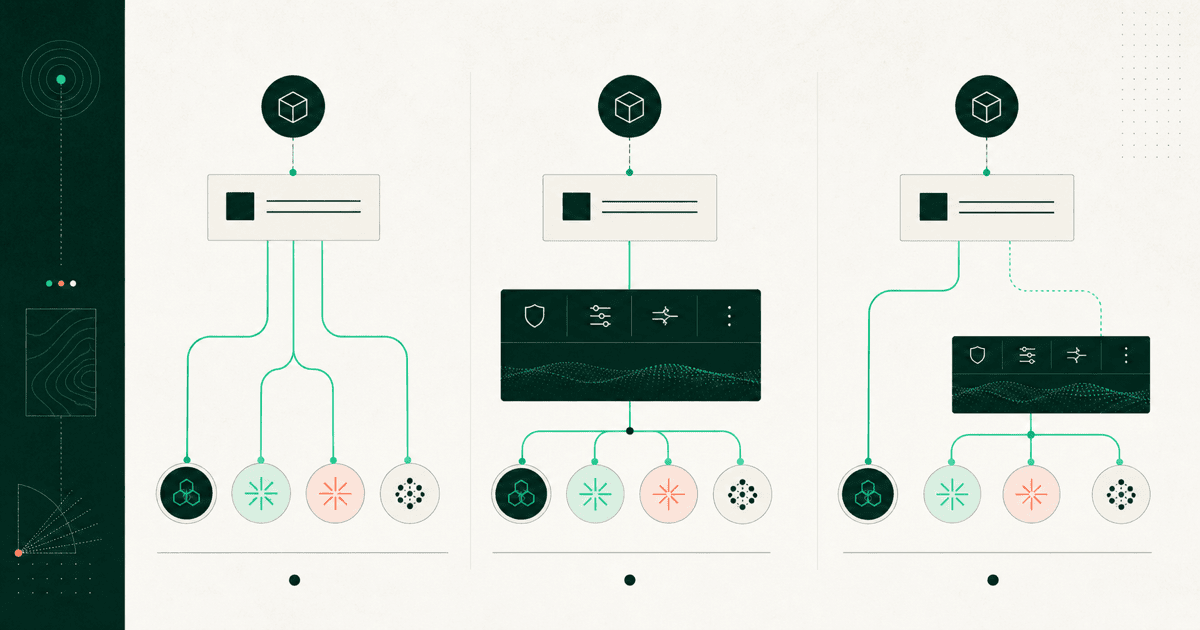
The practical difference
| Decision | Direct provider API | AI gateway |
|---|---|---|
| API contract | Provider-native and usually first to expose new features | Compatible or normalized contract with documented boundaries |
| Credentials | One set per provider and environment | Gateway key, plus operator or customer upstream credentials |
| Billing | Provider invoice and contract | Gateway credits, BYOK, platform fees or a hybrid model |
| Model discovery | Provider catalog | Multi-provider or curated gateway catalog |
| Routing | Application chooses and implements it | Gateway can centralize eligible routes and policy |
| Evidence | Provider logs and application telemetry | Gateway request record plus upstream evidence where exposed |
| Failure domain | Provider and application integration | Gateway, provider and any policy or storage dependencies |
Neither approach is inherently more reliable or secure. Direct integration removes an intermediary but can duplicate keys, retry logic and accounting across services. A gateway centralizes those concerns and becomes another trust and availability boundary.
Direct access is better for native depth
Use the provider API when the product depends on a newly released endpoint, exact reasoning controls, batch operations, fine-tuning, provider-specific tools, a cloud deployment contract or support escalation tied to that account. Compatibility layers often cover common operations first and may translate, ignore or reject provider-specific fields.
Direct access also fits a small workload with one owner, one provider and no shared cost or audit requirement. The simplest architecture that meets the contract is usually easier to debug.
A gateway is better for shared policy
Use a gateway when several applications repeat the same authentication, model catalog, usage attribution, limits, retry policy or provider integration. It can make one scoped key and one request evidence model available across teams. Managed access can also remove provider onboarding. BYOK can preserve direct provider contracts while centralizing control.
Read when to use an AI gateway for the adoption signals and AI gateway versus API gateway if an enterprise traffic layer already exists.
Do not confuse syntax with portability
An OpenAI-compatible request can reduce SDK changes, but the selected model still has its own tool quality, safety behavior, token limits, error semantics and stream events. Anthropic Messages and OpenAI Responses are separate contracts. Images, audio and embeddings often use specialized routes.
The OpenAI compatibility answer and migration checklist provide a field-level test. Keep a provider-native path when a feature cannot be represented safely through the gateway.
Produce a route decision register
Create one row for every production operation, not one row per provider. Include chat, Responses-style agent turns, Messages-style calls, embeddings, image or audio work, batch jobs and fine-tuning only when the application actually uses them. The row should name the current endpoint, required model behavior, provider-specific fields, authentication owner, data classification, retry rule, usage owner and rollback route.
Assign each row one of three decisions: gateway, direct, or temporary exception. A gateway decision requires a recorded fixture that passes through the proposed gateway with the expected stream events, tool arguments, usage and error handling. A direct decision must name the native capability or contract that the gateway cannot represent. A temporary exception needs an owner, an expiry condition and the event that triggers retesting, such as a gateway adding the required endpoint.
Store the register beside deployment configuration so the production route and the approved route cannot drift silently. Link each row to the relevant contract test and data-flow review. The result is a deployable routing map. It also prevents a broad "gateway migration" project from hiding one operation that still depends on a provider SDK or account-specific feature.
Compare both paths with the same workload
- Freeze the endpoint, model revision, prompt, tools and output cap.
- Run direct and gateway requests from the same client region.
- Capture time to first token, terminal state, usage, charge and error body.
- Test invalid auth, rate limits, timeout, streaming cancellation and tool continuation.
- Inspect data logging and retention on every company in the path.
- Calculate staff and infrastructure work as well as inference price.
- Decide which native features may bypass the gateway and document that exception.
Use does a gateway add latency for measurement and is an AI gateway secure for the data-flow review.
Bound migration cost and the claims your evidence supports
Start the cost sheet with the current direct path. Include provider charges plus the work of maintaining SDKs, rotating credentials, updating error handling, reconciling invoices and repeating audit controls across applications. Then add the proposed gateway path: model charges, any gateway or platform charge, integration work, telemetry storage, the extra availability boundary and the staff who will own routing policy. A split design carries both sets of controls, so include duplicate monitors, runbooks and security reviews instead of treating the direct exceptions as free.
Migrate one reversible operation at a time. Freeze its model, payload, output limit and client region, then compare successful calls, streaming cancellation, tool continuation, throttling, timeouts and malformed requests. Keep the old route available until usage and billing records reconcile, incident ownership is assigned, and rollback has been exercised. The migration checklist supplies field-level cases; the route register determines which ones apply.
Limit each conclusion to the evidence collected. A provider invoice proves the provider charge, but not the gateway's internal route. A gateway log proves what that layer recorded, but not that an upstream invoice has settled. A latency sample from one model and region does not establish a general speed result. Record assumptions beside estimates and reopen the decision when an endpoint, contract, data rule or workload changes.
Keep one native feature without duplicating the whole application
Suppose most requests are ordinary chat but one workflow depends on a provider-specific hosted tool. Keep that workflow behind a native adapter and send only supported chat operations through a gateway. Share application authorization and task accounting above both adapters. The OpenAI API reference identifies native operations; the destination gateway must separately document its support. A split design can avoid rewriting a working feature, provided errors and costs remain visible across both paths.
A split architecture can be the honest answer
A team can route common text and agent workloads through a gateway while keeping fine-tuning, batch jobs or a unique modality direct. Centralize only the policy that is truly shared. Keep request identifiers and cost ownership consistent enough that both paths can be operated during an incident.
Frequently asked questions
Is a direct API always faster?
It removes one gateway hop, but total latency depends on network, provider routing, retries and generation. Measure both paths.
Does a gateway hide every provider difference?
No. It can normalize selected request shapes, but model features, limits, errors and behavior still differ.
Can I use both direct and gateway routes?
Yes. Keep provider-native operations direct and use the gateway for workloads that benefit from shared policy, then document the split.
Which path is easier to bill?
One managed gateway can simplify customer billing. Direct and BYOK paths preserve provider invoices but may require more internal attribution.
When should I move from direct APIs to a gateway?
Move when duplicated credentials, integrations, routing, spend controls or request evidence create more work than the gateway adds.
Sources reviewed
Sources last reviewed 2026-08-15
- [1] OpenAI API reference
- [2] Anthropic API overview
- [3] Amazon Bedrock APIs
- [4] Vercel AI Gateway
- [5] Cloudflare AI Gateway
- [6] KeepRouter OpenAPI
Related guides
- When should you use an AI gateway?
- What is the difference between an AI gateway and an API gateway?
- What is an OpenAI-compatible API?
- KeepRouter vs Amazon Bedrock
- KeepRouter vs Gemini Enterprise Agent Platform
- KeepRouter vs Microsoft Foundry
- KeepRouter vs Hugging Face Inference Providers
- OpenAI-compatible API migration checklist
- Does an AI gateway add latency?
- Is an AI gateway secure?
- Best AI gateways by use case
- models